Crash Games Explained: Multipliers, Cash-Out and Risk
How crash games work: rising multipliers, cash-out timing, auto cash-out, 'provably fair' claims and why fast rounds make crash games easy to over-play.
Key takeaways
- A multiplier rises from 1.00x until it 'crashes' at a random point; you must cash out before the crash to win.
- The crash point is decided at the start of the round, not by when players cash out.
- Higher cash-out targets pay more but succeed less often; the house edge applies at every target.
- Rounds last seconds, which makes it easy to play far more than intended.
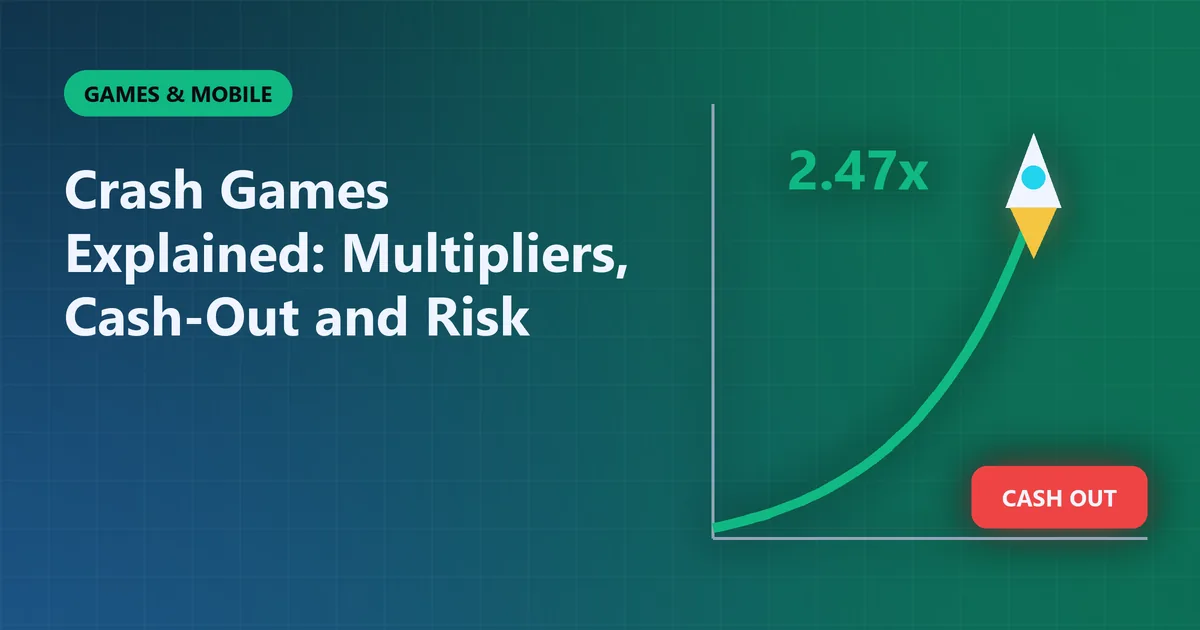
Crash games are among the fastest-growing instant games. A line or rocket climbs, a multiplier ticks upwards, and you decide when to cash out. If the game crashes first, the stake is lost. The format feels like a test of nerve, but the maths is as fixed as any slot. For other categories, see our JKB Asia games overview.
How a round works
- Place a bet before the round starts. Many games allow two bets at once.
- The multiplier rises. It starts at 1.00x and increases.
- Cash out or set auto cash-out. Cashing out at 2.00x returns twice your stake.
- The crash. At a random point the round ends. Any bet not cashed out is lost.
When is the crash point decided?
In most crash games the crash point is generated by a random number process at the start of the round. Watching other players cash out, or waiting a few rounds after a high multiplier, does not change it.
The trade-off between target and probability
Crash games are designed so that the expected return is roughly the same whatever target you choose. Low targets (1.2x) succeed often but pay little; high targets (10x) pay well but rarely succeed. Some rounds crash almost immediately, which is one way the game builds in its edge.
| Auto cash-out target | How often it succeeds | What you win on RM10 |
|---|---|---|
| 1.20x | Most rounds | RM2 profit |
| 2.00x | Roughly half of rounds or a little less | RM10 profit |
| 10.00x | Roughly one round in ten or fewer | RM90 profit |
“Provably fair”
Some crash games are labelled “provably fair”. This usually means the game publishes a cryptographic hash of each round's result in advance, so you can check afterwards that the result wasn't changed. It can show that a round wasn't altered; it does not mean the game has no house edge.
The real risk: speed
Rounds can last just a few seconds, and auto-bet features can run continuously. Combined with the excitement of near-misses (“it went to 50x right after I cashed out!”), crash games make it very easy to over-play. If you play, set a fixed number of rounds or a fixed budget and turn off auto-bet.
Which crash or instant games are available under the JKB Asia name has not been verified by us. Information may vary and should be confirmed through the relevant official source.
Conclusion
Crash games are simple chance games priced like any other casino game. Your timing changes how often you win and by how much, not the long-run cost. Their speed is the main danger.
Frequently asked questions
Is there a best time to cash out in a crash game?
No target beats the built-in house edge. Lower targets just give smaller, more frequent wins.
Does 'provably fair' mean I can't lose?
No. It means a round's result can be checked as unchanged. The game still has an edge.
Gambling involves real financial risk and is never a reliable way to earn money. Only take part if you are an adult, it is legal where you live, and you are using money you can afford to lose. If gambling is causing stress, see our responsible gambling page for support options.