Sic Bo Guide: How the Dice Game Works and Which Bets Cost Most
How to play sic bo, the three-dice casino game popular in Malaysia: Big and Small, triples, totals and single-number bets, with probabilities and house edge for each.
Key takeaways
- Sic bo uses three dice, giving 216 equally likely outcomes.
- Big and Small pay 1 to 1 and lose to any triple, giving a house edge of about 2.8%.
- High-paying bets such as specific triples carry much higher house edges, often 15% or more.
- Payouts vary between tables, so the same bet can cost more at one table than another.
Sic bo (also known as “big and small” or tai sai) is a traditional dice game that is popular across Malaysia and the region. The table looks complicated, but every bet comes down to simple probabilities from three dice. This guide shows which bets are reasonably priced and which are expensive. For an overview of other live games, see live casino games explained.
How sic bo works
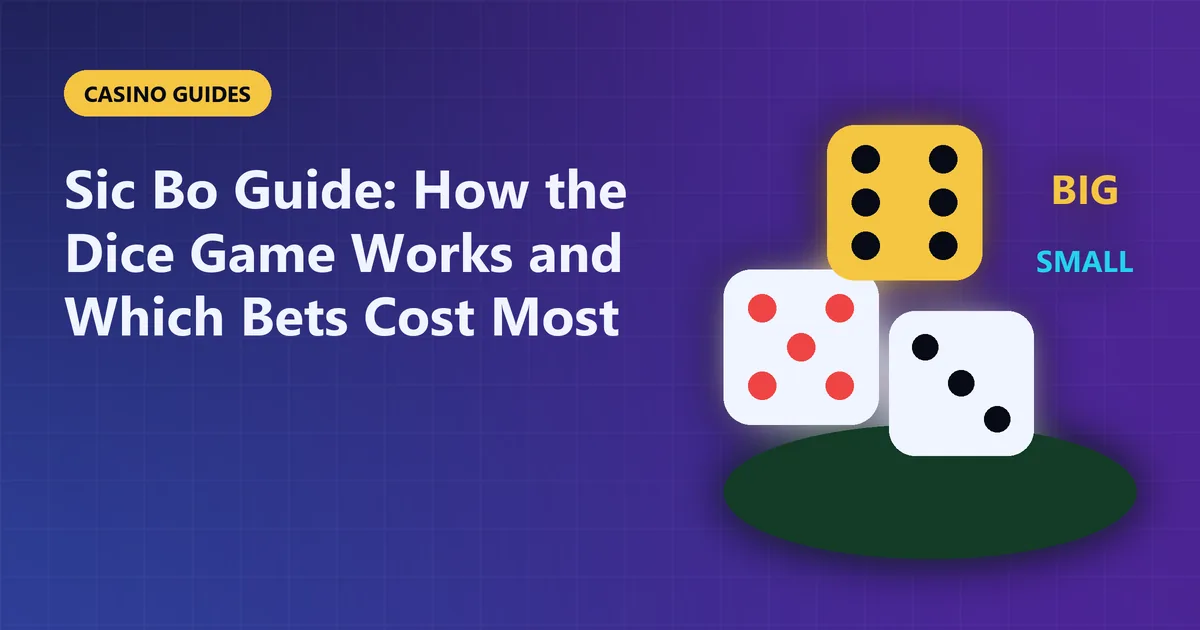
Three dice are shaken in a covered container. Each die shows 1–6, so there are 6 × 6 × 6 = 216 possible outcomes, each equally likely. You bet on the result: the total, specific numbers, doubles or triples.
Bets and their real cost
Payouts below are common examples. Tables differ, and a lower payout raises the house edge, so always check the paytable.
| Bet | Wins when | Example payout | Approx. house edge |
|---|---|---|---|
| Big | Total 11–17, not a triple | 1 to 1 | 2.8% |
| Small | Total 4–10, not a triple | 1 to 1 | 2.8% |
| Single number | Chosen number appears 1, 2 or 3 times | 1:1 / 2:1 / 3:1 | 7.9% |
| Any triple | All three dice match | 30 to 1 | 13.9% |
| Specific triple | All three show your number | 180 to 1 | 16.2% |
| Total of 4 (or 17) | Dice total exactly 4 | 60 to 1 | 15.3% |
Why Big and Small are the cheapest bets
Big and Small each cover just under half of all outcomes. Without the triple rule, they would be even. The six triples (1-1-1 through 6-6-6) are 6 of the 216 outcomes; because Big and Small lose on all of them, the house gains its edge of 6 ÷ 216 ≈ 2.8%.
Why the big payouts are expensive
A specific triple happens once in 216 rolls. A fair payout would be 215 to 1. Paying 180 to 1 means the house keeps about 16% of the money bet on it over time. The same pattern applies to most long-shot bets: the bigger the payout, the more room the house has to price it unfairly.
To compare any bet, divide the number of winning outcomes by 216 to get the probability, then compare the payout with what would be fair. The gap is the house edge.
Patterns and “trends”
Live sic bo tables often show recent results and Big/Small streaks. Dice have no memory: after six Bigs in a row, the next roll is exactly as likely to be Big as it was before.
Sic bo tables and payouts available under the JKB Asia name have not been independently verified. Information may vary and should be confirmed through the relevant official source.
Conclusion
If you play sic bo, Big and Small are the most reasonably priced bets on most tables. Treat triples and specific totals as expensive extras, read the payout table at each table, and keep to a fixed budget.
Frequently asked questions
What happens to a Big bet if a triple 5 is rolled?
It loses. Big and Small both lose on any triple, which is where their house edge comes from.
Are sic bo payouts the same at every table?
No. Payouts vary, especially on triples and totals. Always check the paytable.
Gambling involves real financial risk and is never a reliable way to earn money. Only take part if you are an adult, it is legal where you live, and you are using money you can afford to lose. If gambling is causing stress, see our responsible gambling page for support options.