How Slot RTP and Volatility Work: A Plain-English Guide
What slot RTP and volatility really mean, with simple RM examples: why a 96% RTP slot can still empty a balance, and how to compare slots for Malaysian players.
Key takeaways
- RTP is a long-run design average across millions of spins, not a prediction for your session.
- House edge is simply 100% minus RTP: a 96% RTP slot has a 4% edge.
- Volatility describes how wins are spread out; it decides how bumpy a session feels.
- Expected cost per hour depends on stake, spin speed and house edge together.
Two numbers come up in every slot discussion: RTP and volatility. They are often misunderstood — usually in ways that make games look better than they are. This guide explains both with simple ringgit examples, so you can compare the slots you find on the JKB Asia slots page or anywhere else.
What RTP actually measures
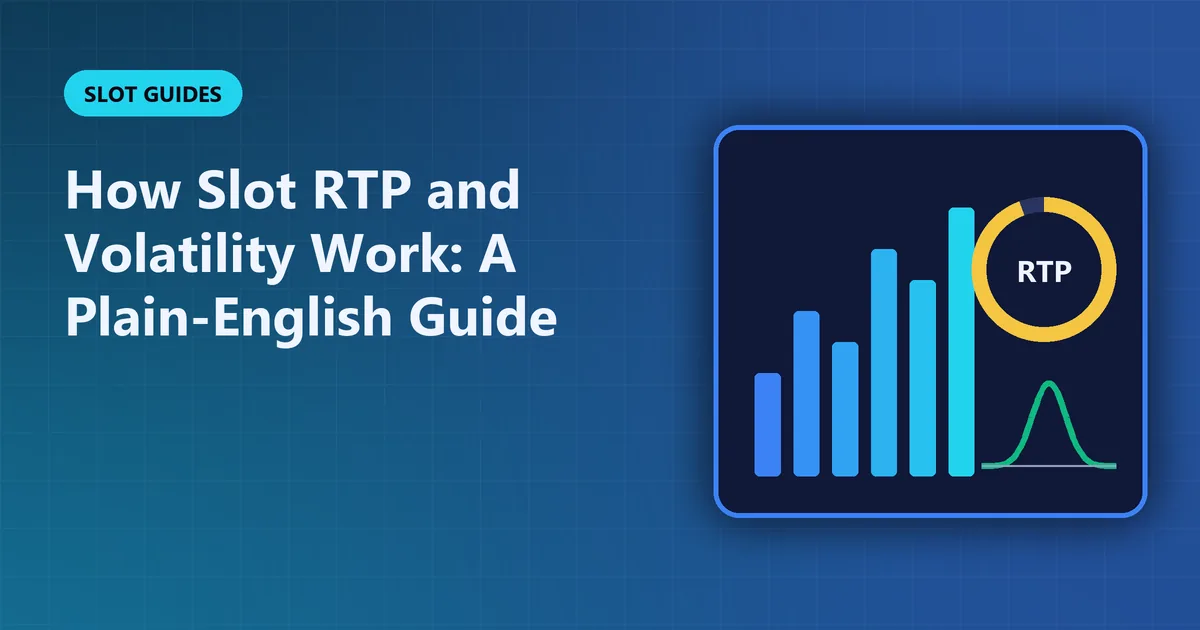
Return to player (RTP) is the percentage of all money wagered on a slot that the game is designed to pay back as winnings, calculated over an extremely large number of spins. A 96% RTP slot is designed to return RM96 for every RM100 staked in total, across all players, over the long run.
The other side of RTP is the house edge: 100% minus RTP. For a 96% slot, the house edge is 4%. That 4% is what the game is designed to keep on average.
Why your session rarely matches the RTP
In a short session, randomness dominates. You might hit a feature early and finish well ahead, or go a hundred spins without a meaningful win. The RTP only becomes visible across a volume of play no individual player ever reaches. That is why RTP is useful for comparing games, but useless for predicting a session.
Turning house edge into an expected cost
A more practical way to use RTP is to estimate the average cost of playing. The formula is:
Expected cost = total amount staked × house edge
| Stake per spin | Spins per hour | Total staked | RTP | Expected cost |
|---|---|---|---|---|
| RM0.50 | 400 | RM200 | 96% | RM8 |
| RM1.00 | 400 | RM400 | 96% | RM16 |
| RM1.00 | 400 | RM400 | 94% | RM24 |
| RM2.00 | 600 | RM1,200 | 96% | RM48 |
Notice what moves the number most: stake and speed. Auto-spin and turbo modes increase spins per hour, which increases expected cost even though the RTP is unchanged.
What volatility means
Volatility (or variance) describes how a game's RTP is distributed between small and large wins.
Low volatility
Frequent small wins, few big ones. Balances tend to move gradually. Suits players who want longer sessions on a fixed budget.
Medium volatility
A mix: regular small wins with occasional larger features.
High volatility
Long stretches with little return, punctuated by rare large wins — usually from bonus rounds. Balances can drop quickly. Games with very high maximum wins are almost always in this group.
Two slots can both be 96% RTP and feel completely different. A low-volatility game might return its 96% through hundreds of small wins; a high-volatility game might return much of it through a feature most players never trigger.
How to find a slot's volatility
Many developers state volatility in the rules screen (sometimes as a scale such as 1–5 lightning bolts). If it is not listed, clues include a very high maximum win, a large gap between low and premium symbol payouts, and a buy-feature price of 100× stake or more.
Progressive jackpots and RTP
In progressive jackpot slots, part of each stake funds the jackpot. The base game RTP is often lower as a result, and the jackpot share only “returns” to the rare player who wins it. If you are unlikely to hit the jackpot, the effective RTP of your play is lower than the headline figure.
Common myths
- “This slot is due to pay.” Each spin is independent. Previous spins do not affect the next.
- “Higher stakes improve RTP.” On most slots RTP is the same at every stake.
- “RTP changes during the day.” A game's RTP version is a configuration setting, not something that shifts by time.
Conclusion
Use RTP to compare games and to estimate the average cost of your play. Use volatility to decide what kind of session you can afford. Neither number can tell you what will happen next — and nothing else can either. For a full walkthrough of a slot's information screen, see our JKB Asia slot guide, and for comparing table games, see the house edge table in our casino guide.
Frequently asked questions
Is 96% RTP good?
Many modern online slots are released with RTPs in the mid-90s. Higher RTP means a lower house edge, but it never guarantees a winning session.
Does volatility change the RTP?
No. Volatility changes how wins are distributed, not the long-run average return.
Gambling involves real financial risk and is never a reliable way to earn money. Only take part if you are an adult, it is legal where you live, and you are using money you can afford to lose. If gambling is causing stress, see our responsible gambling page for support options.