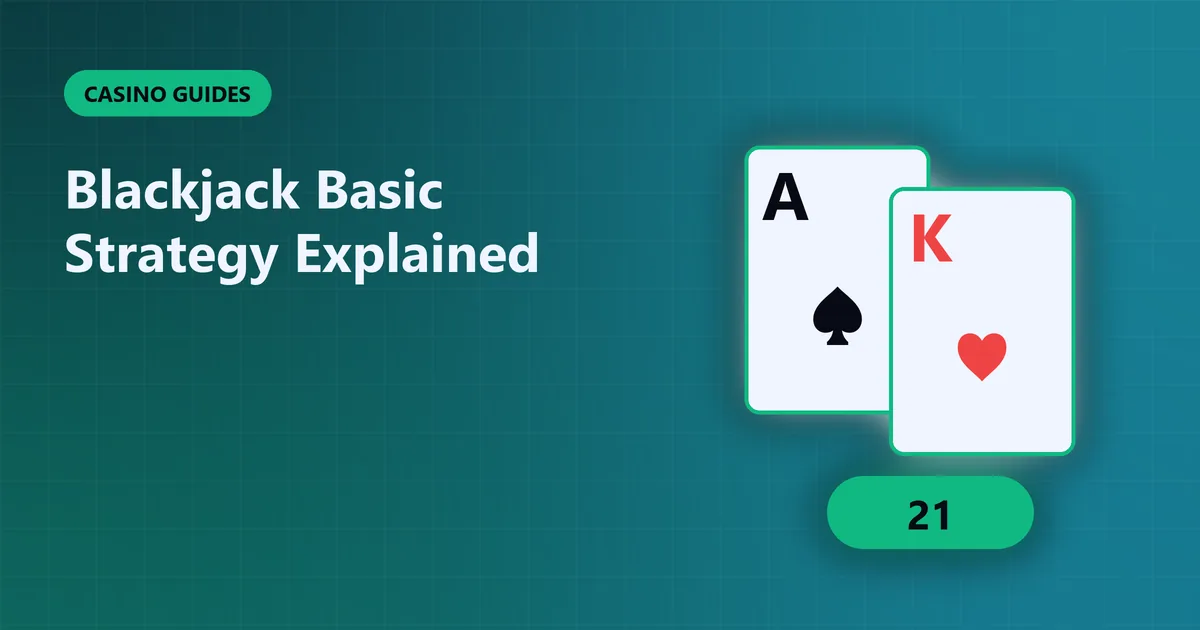
Blackjack Basic Strategy Explained
Learn blackjack basic strategy in plain English: core decisions, when to split and double, why insurance is a poor bet, and how table rules change the house edge.
Key takeaways
- Basic strategy is the mathematically best decision for each hand against each dealer upcard.
- It lowers the house edge, typically to roughly 0.5%–1% depending on rules, but does not remove it.
- Table rules matter: 3:2 blackjack payouts are much better for you than 6:5.
- Insurance is a side bet with a poor return for players who are not counting cards.
Blackjack is the one common casino game where your decisions change the odds. Play every hand by instinct and the house edge can be several percent; play by basic strategy and it falls to around half a percent to one percent on good rules. This guide explains the logic so the decisions make sense. For the game's place among other live tables, see live casino games explained.
The basic rules
- Cards 2–10 count at face value, picture cards count 10, aces count 1 or 11.
- You and the dealer get two cards; one of the dealer's cards is face up (the “upcard”).
- You choose to hit, stand, double down (double your bet for exactly one more card) or split a pair into two hands.
- Going over 21 is a bust and loses immediately, even if the dealer later busts too. This is where the house edge comes from.
- The dealer must follow fixed rules, usually drawing to 16 and standing on 17.
The logic behind basic strategy
The dealer's upcard tells you how likely the dealer is to bust. Upcards of 2–6 are “weak” because the dealer often has to draw into a bust. Upcards of 7–Ace are “strong”. Basic strategy is largely about letting a weak dealer bust and fighting harder against a strong one.
Key decisions to remember
| Your hand | Decision |
|---|---|
| Hard 17 or more | Always stand |
| Hard 13–16 | Stand against 2–6; hit against 7–Ace |
| Hard 12 | Stand against 4–6; otherwise hit |
| Hard 11 | Double against 2–10; hit against Ace |
| Hard 10 | Double against 2–9; otherwise hit |
| Hard 9 | Double against 3–6; otherwise hit |
| Hard 8 or less | Always hit |
| Soft 19–21 (e.g. A-8) | Stand |
| Soft 18 (A-7) | Double against 3–6 if allowed, stand against 2, 7, 8; hit against 9–Ace |
| Pair of Aces or 8s | Always split |
| Pair of 10s or 5s | Never split |
Full charts vary slightly by rules (number of decks, whether the dealer hits soft 17, doubling after splits). The table above covers the decisions that come up most often.
Why insurance is a poor bet
When the dealer shows an Ace, you may be offered insurance: a side bet that the dealer has blackjack, paying 2 to 1. In a multi-deck shoe the dealer's hole card is a ten-value card less than a third of the time, so the bet loses money over time. “Even money” on your own blackjack is the same bet in disguise.
Rules that change the house edge
| Rule | Effect for the player |
|---|---|
| Blackjack pays 6:5 instead of 3:2 | Much worse |
| Dealer hits soft 17 | Slightly worse |
| More decks | Slightly worse |
| Double after split allowed | Slightly better |
| Late surrender allowed | Slightly better |
Of these, the 6:5 payout matters most. Check the table's rules panel before you sit down.
Blackjack tables, rules and limits available under the JKB Asia name have not been independently verified. Information may vary and should be confirmed through the relevant official source.
What basic strategy can't do
It cannot make blackjack a winning game in the long run, and it cannot protect you from losing streaks. It simply makes sure you are not giving away more than the rules require. Combine it with a session budget, and never increase bets to recover losses; our betting systems guide explains why.
Conclusion
Learn the core decisions, avoid insurance, prefer 3:2 tables, and treat basic strategy as a way to reduce cost, not as a path to profit.
Frequently asked questions
Can basic strategy beat blackjack?
No. It minimises the house edge but does not remove it.
Is card counting possible in online blackjack?
RNG blackjack typically reshuffles every hand, and live tables often use continuous shufflers or cut the shoe early, which limits counting. Operators may also restrict players they suspect of counting.
Gambling involves real financial risk and is never a reliable way to earn money. Only take part if you are an adult, it is legal where you live, and you are using money you can afford to lose. If gambling is causing stress, see our responsible gambling page for support options.